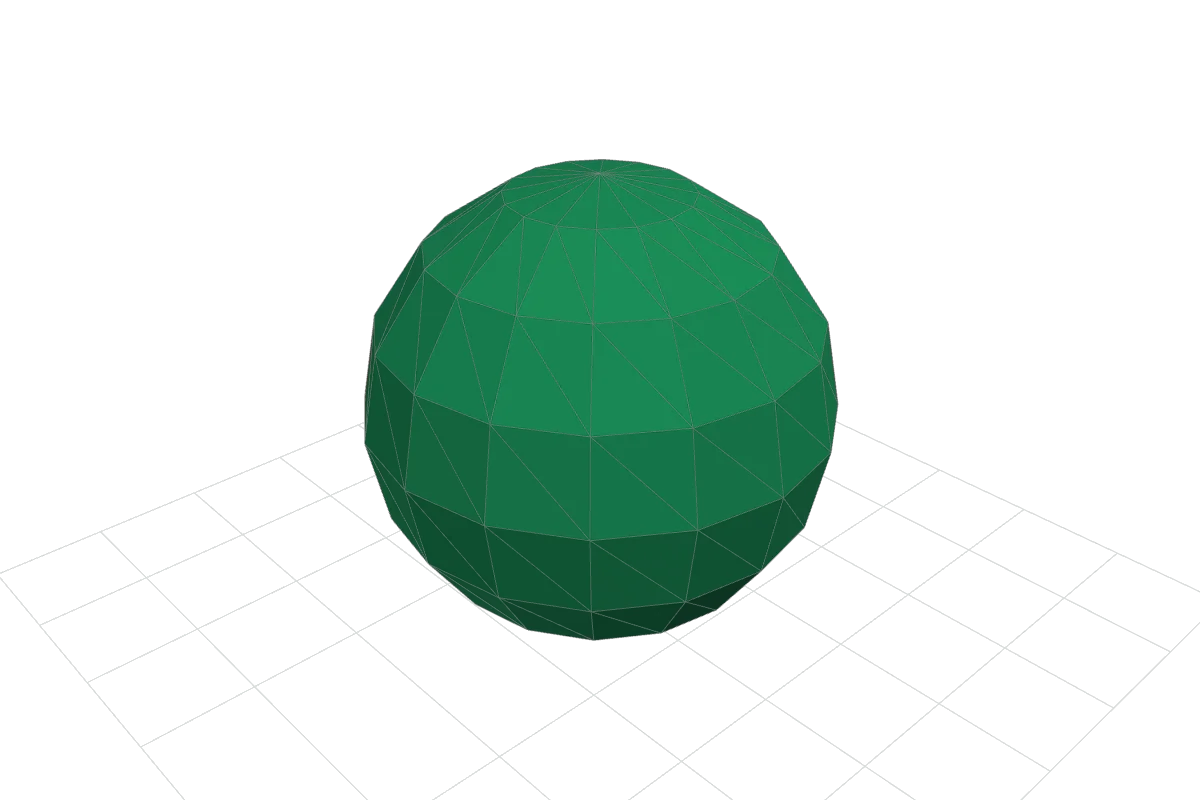
Triangles approximate surfaces
A triangle is planar. Curved objects are approximated by many flat triangles. A cylinder with a small number of radial segments looks visibly faceted; adding segments smooths its silhouette. That can matter for a close-up render or a large print.
A square box does not need thousands of triangles to represent perfectly flat faces. Our 20 mm cube uses just 12 triangles for its six rectangular sides.
Compare controlled examples
Our 20 mm-class low-poly sphere deliberately uses faceted geometry. Its 224 triangles are a design choice and not a claim that it has the accuracy of a smooth mathematical sphere.
The new reference cylinder uses 48 segments around its circular boundary; its caps and sidewalls are made of triangles. More segments would better approximate the theoretical circular silhouette but also add vertices and faces.
Measure useful accuracy
Choose resolution against a tolerance or target appearance, not against a universal triangle-count threshold. For printing, the useful question is whether discretization errors are meaningful relative to nozzle, layer and overall part dimensions.
For interactive web viewing, geometry complexity influences transfer size and rendering cost alongside materials, textures and draw calls. Optimization should preserve visible or functional detail while removing waste.
Worked example
Our exact planar cube needs 12 triangles. A round cylinder uses many more to approximate the perimeter. Comparing only triangle totals would be misleading because the target shapes differ.
Important limitation
Do not decimate a mechanical interface until you know its required dimensional accuracy. A visibly small change can alter a mating hole or sealing surface.
Practical checklist
- Identify the viewing or fabrication scale
- Inspect silhouettes at target size
- Preserve critical mating surfaces
- Measure output file size
- Compare final exports after simplification
Common questions
Will doubling triangle count double quality?
No. Improvement depends on where triangles are added and which errors they reduce.
Does STL carry a smooth analytical circle?
A typical STL mesh contains triangles; a circular edge is tessellated into straight segments.
Triangle count in numbers
We generated the same 20 mm sphere at increasing resolution and measured its volume against the true value of 4,188.8 mm³:
| Segments | Triangles | Volume (mm³) | Shortfall |
|---|---|---|---|
| 8 | 48 | 3,219.0 | 23.2% |
| 16 | 224 | 3,926.6 | 6.3% |
| 64 | 3,968 | 4,172.0 | 0.40% |
| 256 | 65,024 | 4,187.7 | 0.03% |
Flat facets always cut inside a curved surface, so low-poly models are slightly small. Past a few thousand triangles for a part this size, the difference is far below what a printer can reproduce, while the file keeps growing: 65,024 triangles is 3.25 MB as binary STL (benchmark).
Rules of thumb
- Printing: aim for facets smaller than about 0.05–0.1 mm of deviation; slicers cannot print finer.
- Web and AR: tens of thousands of triangles per object, with normal maps for detail (3D on the web).
- Scans: decimate million-triangle scans before slicing or sharing.
Check your understanding
1. Why is a low-poly sphere’s volume smaller than a true sphere’s?
Each facet is a chord across the curve.
2. Doubling the segments of a UV sphere multiplies triangles by roughly…
Both rings and segments double.