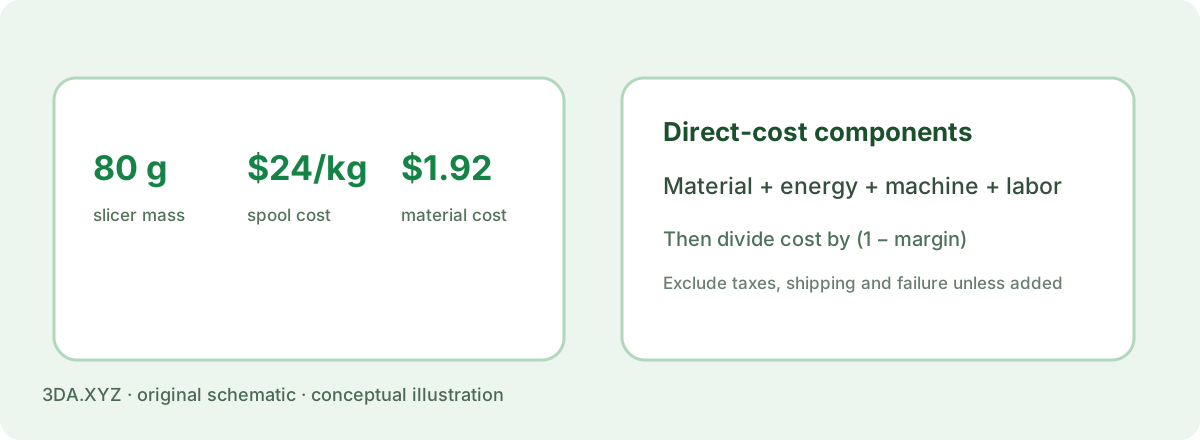
Calculate material cost from grams
If a spool costs $24 per kilogram and the slicer predicts 80 grams including supports, the nominal material cost is 80 ÷ 1000 × $24 = $1.92. This calculation assumes the grams estimate and spool price are accurate.
A part’s enclosing volume multiplied by plastic density is not equivalent to its final material mass when it uses sparse infill, solid walls or support structures. The slicer is the practical place to estimate consumption for a specific job.
Estimate electricity and machine allowance
Electricity is approximately average power in kilowatts multiplied by duration in hours multiplied by price per kilowatt-hour. At a hypothetical average 110 W, six hours and $0.15/kWh, energy costs about $0.099—before other devices or process details.
Machine wear, maintenance and depreciation can be represented as an allowance per print hour. Add hands-on cleanup or packing labor separately. These are business estimates that you control rather than claims about a particular machine’s actual costs.
Use margin correctly
Markup and gross margin are different. A 40% markup on $10 cost yields $14 price, while a target 40% gross margin requires $10 ÷ (1 − 0.40) = approximately $16.67.
The 3DA calculator uses the margin formula and shows each assumption. It is not a tax, shipping, labor-management or full accounting model.
Worked example
80 g at $24/kg = $1.92. If a six-hour job averages 110 W at $0.15/kWh, electricity adds about $0.10, excluding machine allowance and labor.
Important limitation
Do not advertise calculated costs as quotes before checking actual slicer results, failure rates, packaging and selling fees.
Practical checklist
- Use slicer grams including supports
- Enter actual spool price
- Estimate power and duration
- Add machine allowance
- Account for labor and packaging
- Check margin versus markup
Common questions
Why not calculate price from STL volume alone?
Volume does not determine infill, wall configuration, supports or filament density.
Does the calculator store my inputs?
No. The calculator runs locally in your browser; it does not submit them.
Beyond direct costs
For selling prints, add what the calculator leaves out on purpose: failed prints (a 5–10% allowance is common), design time, packaging and shipping, platform and payment fees, and taxes. Price per part, not per gram, once you know your real costs.
Reducing cost per part
- Fewer walls or less infill where strength is not needed (Infill, walls and supports).
- Orientation that avoids supports.
- Batch several parts per plate to share warm-up time.
- Larger nozzles for big, non-detailed parts.
Convert between grams and metres of filament with the filament calculator.