Triangles, edges and incidence
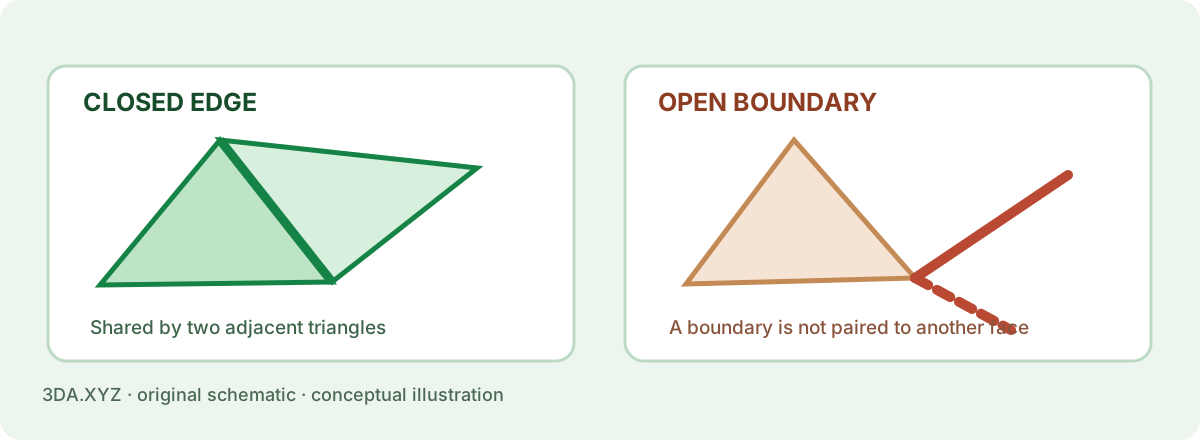
A triangular mesh is made of vertices connected into faces. For an ordinary closed, consistently oriented manifold surface, each undirected edge belongs to exactly two triangles, and the triangles traverse that shared edge in opposite directions.
An edge with one adjacent triangle is a boundary. An edge with three or more adjacent triangles is non-manifold by that edge-incidence test. A zero-area face or duplicate face can confuse the count even when the surface looks acceptable from a distance.
Winding and orientation
Triangle vertex order is used to determine a face orientation. On a closed, consistently wound shell, outward-facing triangles allow signed-volume calculations. A fully inverted closed shell may still be watertight but have a negative signed volume with common conventions.
A normal vector can be computed from the triangle geometry, but some formats also store display normals. Changing display normals without repairing face connectivity is not the same as fixing the actual mesh topology.
What watertight does not prove
A watertight mesh can intersect itself, contain inner shells, have pinched vertex-only connections, include microscopic walls or fail a printer’s physical constraints. A mesh may also contain multiple independent watertight components when you expected one solid.
The 3DA model inspector reports boundary and non-manifold edges, winding conflicts and components. It does not prove self-intersection-free geometry, vertex manifoldness or manufacturability.
Worked example
Our original hollow ring has an inner and outer wall but is still a closed shell. A geometric hole through the middle is not the same as an open boundary in the mesh.
Important limitation
A model with zero boundary edges can still contain invalid intersections or features too small to fabricate.
Practical checklist
- Inspect boundary edges
- Check non-manifold edges
- Review winding conflicts
- Look for isolated components
- Inspect sliced geometry for physical feasibility
Common questions
Can a model have a hole and be watertight?
Yes. A torus or closed hollow ring has a through-hole but no open surface boundary.
Does watertight mean one connected shell?
Not necessarily. Multiple closed components can exist in a single file.
Watertight is a topology question
A mesh is watertight when every edge is shared by exactly two faces. That says nothing about thickness or self-intersection, which is why a watertight model can still print badly. Euler’s formula is a quick extra check: a closed surface with g through-holes has V − E + F = 2 − 2g (mesh topology).
Fixing a mesh that is not watertight
- Weld duplicate vertices (Blender: Merge by Distance).
- Fill open loops (F or Grid Fill).
- Remove internal faces and non-manifold fins.
- Recalculate normals.
- If it is a messy scan, voxel-remesh it.
Full steps: Mesh repair.
Check your understanding
1. Can a watertight mesh still fail to print?
Watertight is necessary, not sufficient.